
1: If it can’t be hit, it means the product quality is poor.
When crushing efficiency decreases, the most common conclusion is:
“This hydraulic breaker is no good.” But in reality, the crushing effect depends on:
o Whether the main unit’s flow rate is matched
o Whether the oil return is smooth
o Whether the oil is clean o Whether there is dry-firing
o Whether the operating conditions have changed
If these factors are not investigated, simply attributing it to product quality is inaccurate. Quality issues exist, but their proportion is far lower than that of system mismatch issues.
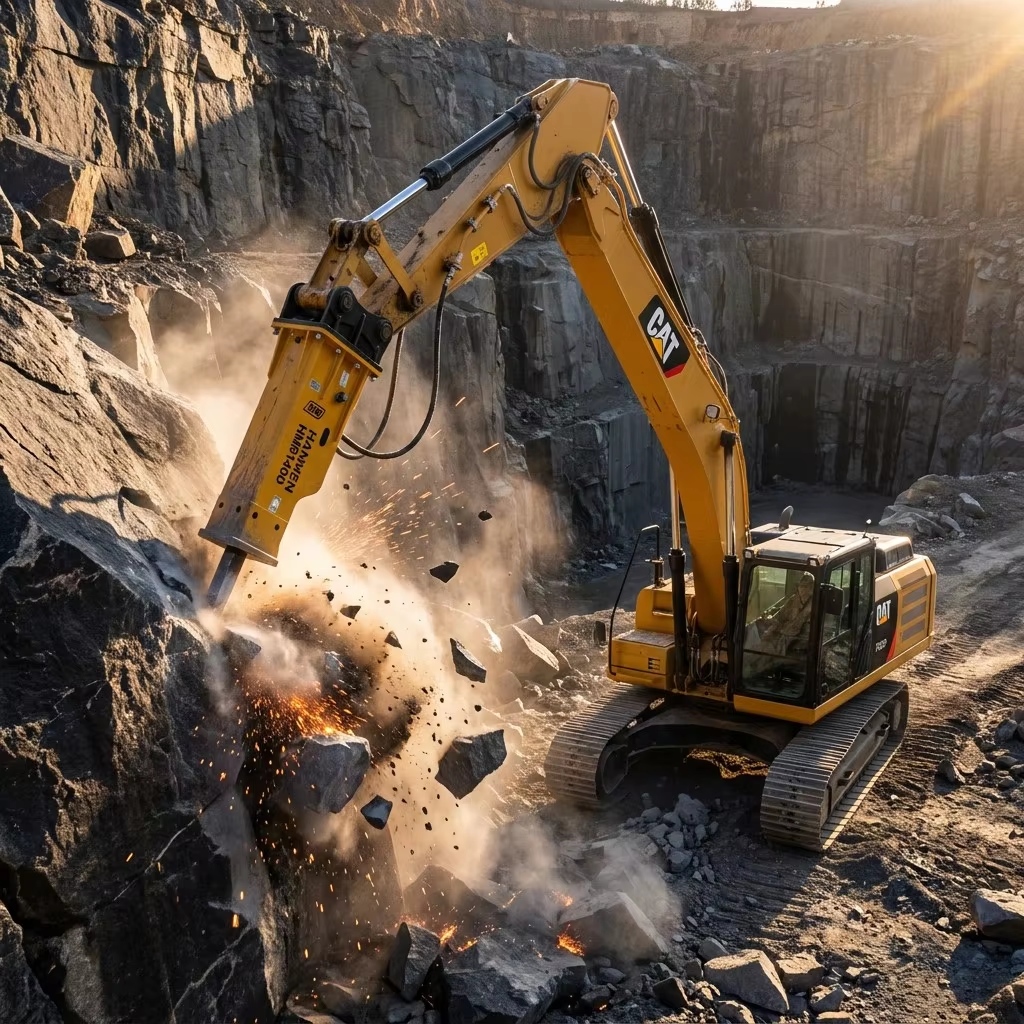
2: Higher frequency is always better.
Higher frequency does indeed mean more impacts per unit time.However, the efficiency formula is not a single variable.
High frequency, if accompanied by:
● Decreased energy per impact
● Unstable impact
● Increased temperature rise
In the long run, it can actually reduce overall efficiency.Attachments should be selected based on material properties, not simply on how fast they “hit.”
3: Higher flow rate always means more power.
When the flow rate exceeds the design range:
o Increased internal throttling o Increased temperature
o Increased sealing burden
It may seem stronger in the short term, but it accelerates wear in the long term. Proper matching is key.
4: Focusing only on the inlet oil, ignoring the return oil path
Many equipment installations only check the pressure and flow rate, neglecting the return oil path.
Problems caused by increased back pressure include:
● Abnormal reversing
● Decreased efficiency
● Shortened seal life Return oil problems are often hidden, yet have far-reaching consequences.
5: Oil leaks always indicate structural damage
Oil leaks may originate from:
● Aging seals
● Excessive back pressure
● Abnormal oil temperature
● Improper installation This does not necessarily mean the main structure is damaged. Blindly replacing the entire assembly will cost far more than addressing the root cause.
6: Attachments are just accessories and don’t require system management.
Many people believe that the main unit requires system maintenance, while attachments are merely “tools.”
However, hydraulic attachments also belong to precision hydraulic systems. They require:
● Cleanliness management
● Temperature monitoring
● Regular inspections
● Calibration and matching. Neglecting management will ultimately manifest in maintenance costs.
7: Efficiency Decline is “Normal Wear and Tear”
Performance degradation is indeed unavoidable.However, the rate of degradation can be controlled.
If:
o Temperature remains consistently high
o Oil contamination is severe
o Back pressure exceeds limits
o Frequent dry runs
The rate of degradation will accelerate significantly. This is not “normal aging,” but rather a system management issue.
Post time: Jun-17-2026


