
Introduction
Many people say a breaker “vibrates” rocks apart.
But in reality, hydraulic breakers don’t rely on vibration. They use high-frequency single impacts.
The crushing effect comes from instant impact energy rather than sustained hydraulic pressure.
Many users overlook the core working mechanism of breakers, resulting in incorrect equipment selection, low crushing efficiency, and unnecessary component wear. This article thoroughly explains the hydraulic breaker working process, energy conversion principle, nitrogen system function, frequency & impact force logic, common empty hitting faults, and host matching rules to help you maximize breaker performance and service life.
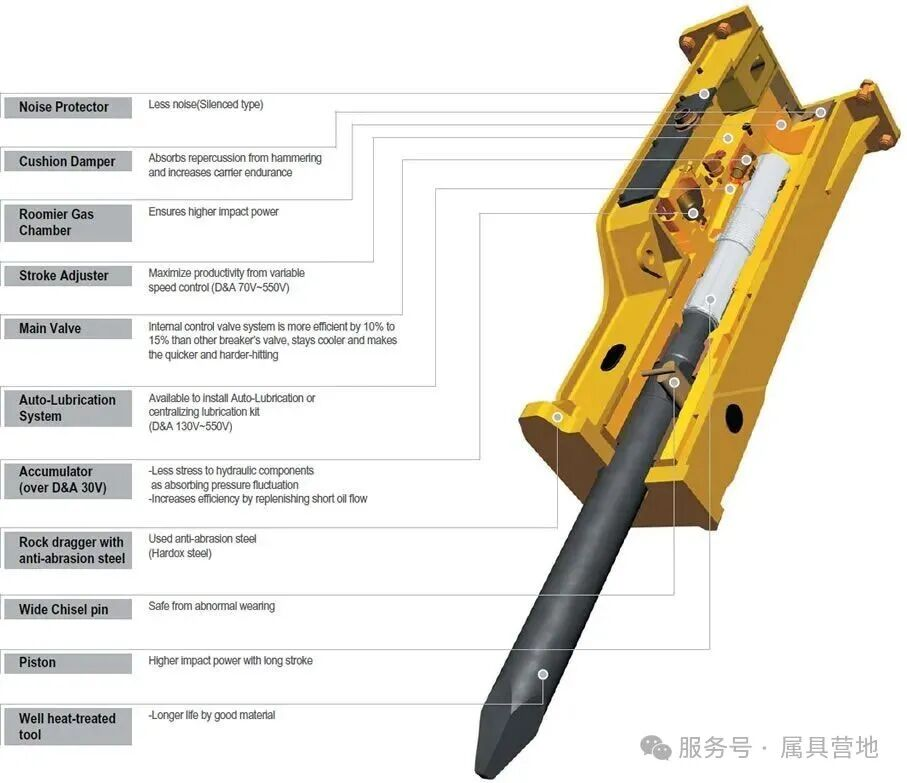
Four Core Working Stages of a Hydraulic Breaker
1) Hydraulic oil enters and pushes the piston.
2) The piston moves upward and compresses the energy storage system.
3) After reversing direction, the piston falls at high speed.
4) The piston hits the drill rod and generates a shock wave. What truly destroys the rock is not the pressure, but the impact energy at that moment.
Where Does the Energy Come From?
The excavator provides hydraulic energy – not “pressure” alone.
The breaker converts hydraulic energy into kinetic energy.
Key factors influencing impact performance:
● Piston mass
● Stroke length
● Impact frequency
● Energy conversion efficiency
This is why different breaker brands or designs perform differently – even on the same excavator.
Why Do Many Breakers Use Nitrogen?
Most traditional breakers use a nitrogen gas chamber as an accumulator.
How nitrogen helps:
Compressed during the piston upstroke (energy storage)
Expands during the downstroke (extra acceleration)
Think of it as a spring that:
Improves impact efficiency
Stabilizes operating frequency
Reduces hydraulic system pulsation
Not All Breakers Need Nitrogen
Some designs (common in Europe and the US, and also developed by companies like HMB uses fully hydraulic energy recovery – no gas chamber required.
Maintenance and tuning differ between nitrogen-charged and all-hydraulic breakers.
Impact Frequency vs. Impact Force – Which Matters More?
Higher frequency is not always better.
Breaking efficiency = Impact energy × Effective blows per minute
● High frequency works better for softer materials
● High single-blow energy is needed for hard, massive rock
If single-blow energy is too low, more blows just mean “empty hitting.”
If energy is too high for soft material, energy is wasted.
Why Does “Idle Blows” (Empty Firing) Happen?
Idle blows occur when the tool bit is not pressed firmly against the material.
Without a reaction force from the rock, the shock wave cannot transfer into the target – so the energy rebounds into the breaker.
Consequences of idle blows:
● Internal impact damage
● Premature seal wear
● Accumulator system issues
Correct operation: Always press the tool against the material before activating the impact function.
Why Excavator-Breaker Matching Is Critical
A breaker is not a “plug-and-play” attachment. Proper matching requires:
● Flow rate (L/min or GPM)
● Operating pressure
● Return line capacity
● Hydraulic cleanliness
Common mismatches:
● Too little flow → weak impact
● Too much flow → overheating
● ΦμmIncorrect pressure → seal damage
Many breaker failures are not caused by the breaker itself – but by poor matching with the host machine.
Final:
Understanding how impact energy is generated, stored, and transferred helps you choose the right breaker, operate it correctly, and avoid costly downtime.
For any questions regarding excavator accessories, please click the (hmbhydraulicbreaker.com) to contact us.
Post time: May-25-2026


